How Wearing the Same Outfit Formula Every Week Quietly Reduces Decision Fatigue
David Park
06/30/2026
6 min read
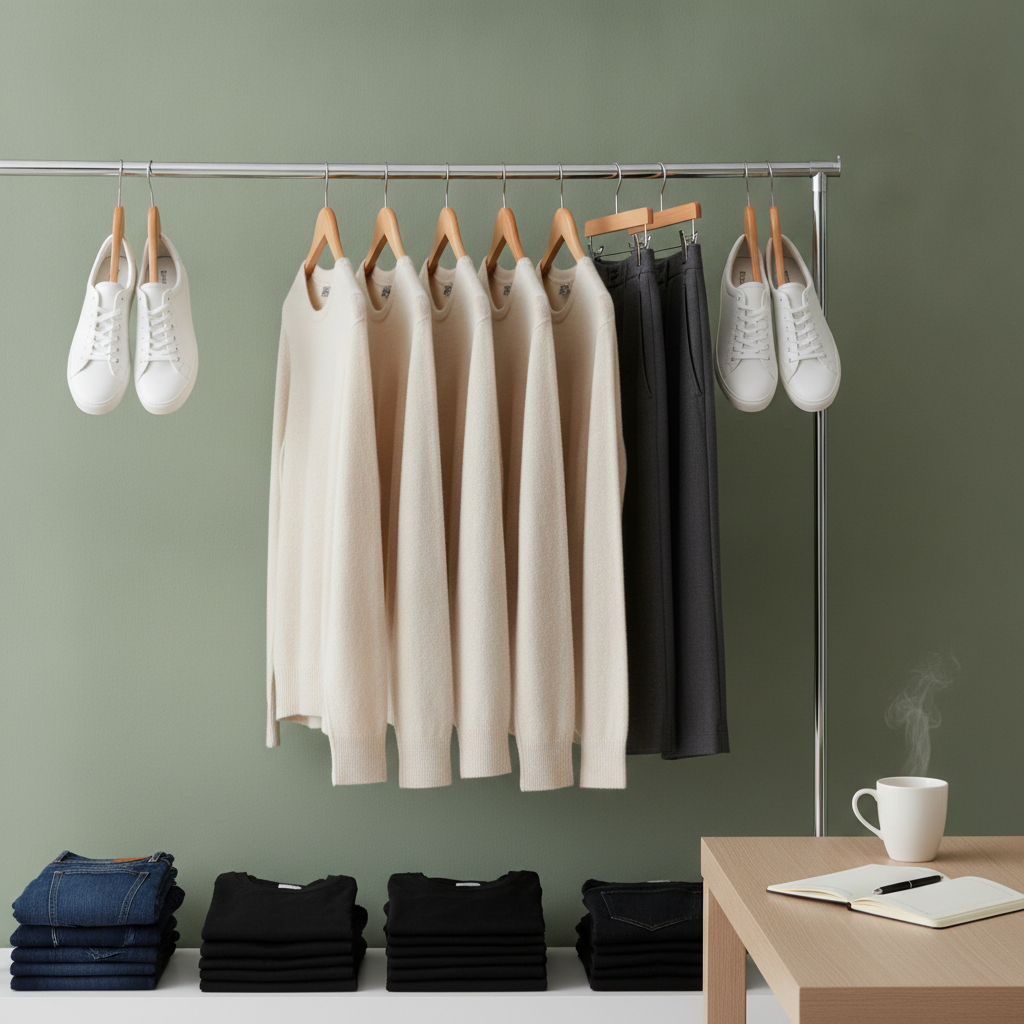
The clothes a person reaches for each morning carry more cognitive weight than most people ever stop to consider. Before the day has properly begun — before the first email or the commute or the meeting that could have been a message — the brain is already working, sorting through options, running low-level calculations about what fits the weather, the occasion, the mood, and the image one wants to project. This happens dozens of times a week, accumulating into something researchers and productivity thinkers have come to call decision fatigue: the gradual erosion of mental clarity that results from making too many small choices. The wardrobe, it turns out, is one of the quieter culprits.
The Weight of the Open Wardrobe
A closet full of options is generally understood as a kind of freedom. The reality is more complicated. When a wardrobe contains too many variables — pieces that don't quite work together, items kept out of obligation rather than use, trends purchased in enthusiasm and worn once — the act of getting dressed becomes a problem to be solved rather than a ritual to be completed. Cognitive load, which is the mental effort required to process information and make decisions, rises with each additional variable. Even when the choices feel trivial, the brain registers them as real work. Over the course of a week, that work adds up, leaving less capacity for decisions that genuinely matter.
The concept of an outfit formula offers a structural solution. Rather than starting from scratch each morning, a person commits to a repeating framework: a specific combination of garment categories, silhouettes, and a limited color palette that can be rotated through with minimal deliberation. Think of it as a personal uniform without the rigidity of literal uniformity — the pieces change, but the logic stays constant. A dark trouser, a well-fitted top in a neutral tone, a single layering piece, and one considered accessory. The formula varies by person, by lifestyle, by profession, but the principle holds regardless of context.
Capsule Thinking and the Logic of Constraint
The capsule wardrobe — a term popularized by the British boutique owner Susie Faux in the 1970s and later brought to wider attention by Donna Karan's Seven Easy Pieces collection — is perhaps the most well-known application of this kind of thinking. Its core premise is that a small number of versatile, high-quality pieces, carefully chosen to work together, outperforms a much larger collection of disconnected items. The capsule is not about minimalism as an aesthetic end in itself; it's about function. When every item in a wardrobe belongs to the same visual language, the formula emerges naturally from the collection itself.
Brands like Everlane and COS have built significant audiences around this logic, offering tightly edited ranges in which each piece is designed to sit alongside the others. The appeal is partly ethical — fewer, better things — but it's also deeply practical. When a person knows that any top in their wardrobe will work with any bottom, the morning decision collapses from a combinatorial puzzle into a simple rotation. The mental energy that was spent on outfit assembly is simply redirected elsewhere.
The Neurological Case for Ritual
Habitual behavior — action governed by established routine rather than active deliberation — places significantly lower demands on the prefrontal cortex, the region of the brain most associated with executive function and decision-making. When a behavior becomes routine, it shifts toward more automatic processing, freeing up attentional resources for tasks that require genuine cognitive engagement. Dressing by formula is, in this sense, a designed habit: a structure deliberately built so that the behavior can run on lower cognitive power. The person who wears a variation of the same outfit every Tuesday is not being boring; they are being efficient in a way that has real downstream effects on the quality of thought available for the rest of the day.
This is part of what made the so-called uniform dressing of figures like Steve Jobs — the black turtleneck and jeans — so widely discussed, and occasionally misunderstood. The point was never the outfit itself. It was the removal of a daily decision from a finite pool of mental resources. The formula was the strategy; the clothes were almost incidental.
Building a Formula That Actually Works
The practical challenge is that most wardrobes weren't built with a formula in mind. They accumulated. Pieces were added reactively — for a specific event, during a sale, in response to a trend — and the collection as a whole developed no internal logic. Building a workable formula usually requires some initial editing before it can run on its own. The most effective approach is to identify the two or three outfits that feel most comfortable and most consistently right, and then work backward to understand what those outfits share: the silhouette, the color range, the level of formality. That shared logic becomes the template.
From there, future purchases can be evaluated against the formula rather than considered in isolation. A piece that fits the formula gets added; one that doesn't, regardless of how appealing it is on its own, gets passed over. Apps like Stylebook, which allow users to catalogue their wardrobe and track what actually gets worn, can be useful during this audit phase, surfacing patterns that aren't always obvious from daily experience alone.
Wearing Your Thinking Room
If you've begun to experiment with this kind of structure, the shift tends to be felt before it's consciously named. Mornings become quieter. There's a small but noticeable sense of order at the start of the day that carries into the first few hours — not because the clothes are particularly remarkable, but because the decision has already been made, in a sense, before you ever open the wardrobe. The formula handles the question. You simply show up to execute it.
This is the understated value of constraint in personal style: it doesn't diminish the experience of getting dressed, but it relocates the creative effort from daily improvisation to occasional curation. The thinking happens once, thoughtfully, and then the routine carries it forward. What looks, from the outside, like a quiet lack of variety is, from the inside, a kind of practiced clarity — the same clarity that tends to show up, in some form, at the other end of a well-organized day.
The clothes a person wears every morning are, in this sense, much more than a surface presentation. They are one of the first acts of the mind, a small but meaningful negotiation between energy and choice. When that negotiation is settled in advance, what remains is simply the day itself — and the thinking one actually wanted to do with it.