Why Booking the Shoulder Season Changes What You Actually Experience at Popular Destinations
Robert Kim
06/28/2026
5 min read
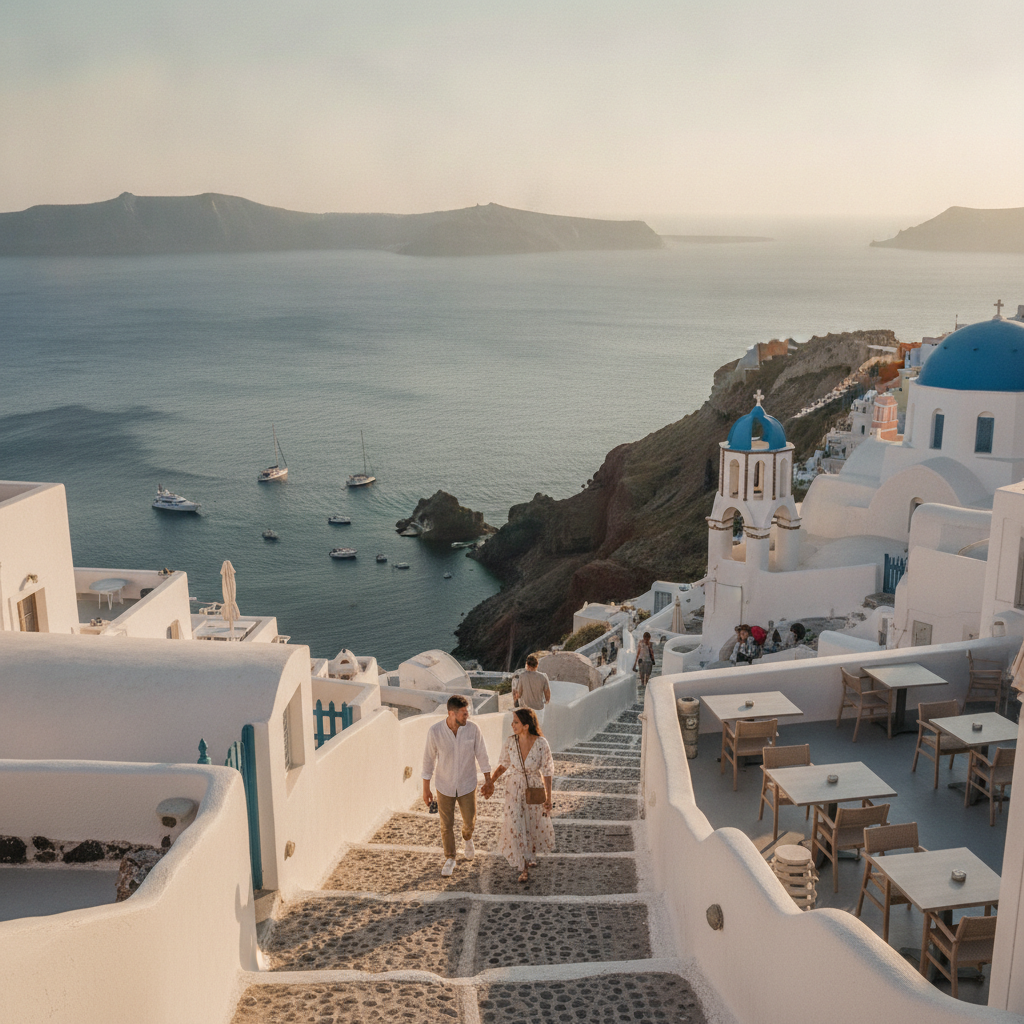
There is a version of the Amalfi Coast that most people never see. Not because it's hidden, exactly, but because it exists only in the weeks before the summer crowds arrive and the weeks after they leave — when the clifftop towns breathe a little easier, when the restaurant owners have time to talk, and when the light on the water looks the same as it always has, unmediated by a thousand raised phones. This version of a place isn't secret. It simply requires arriving at a different time.
The Quiet Logic of Traveling Between Seasons
Shoulder season — the period between a destination's peak tourist months and its quieter off-season — occupies a peculiar middle ground that most travelers overlook in favor of convenience. High season offers predictability: open attractions, reliable weather, the social reassurance of being somewhere during its most celebrated time. Off-season travel, by contrast, carries real trade-offs — closed museums, limited ferry schedules, guesthouses shuttered until spring. The shoulder season sidesteps both extremes. In practical terms, this often means April through May or September through October for Mediterranean destinations, late spring and early fall for Southeast Asia, or the weeks flanking monsoon season in places like Bali or Sri Lanka. The windows vary, but the logic stays consistent: you arrive when the place is fully functional but not fully overwhelmed.
What changes isn't just the crowd count. It's the entire register of the experience. A market in Marrakech's medina feels fundamentally different in October than in July — the vendors are less aggressive, the heat less oppressive, the negotiation more relaxed on both sides. The souk (the traditional market quarter) becomes somewhere to linger rather than survive. Travelers who've made the same trip twice, once in peak season and once during shoulder months, often describe them as almost incomparable experiences — same geography, entirely different texture.
What the Price Difference Actually Reflects
There's a practical dimension to shoulder season travel that deserves honest attention. Flights, accommodation, and tour bookings all tend to drop meaningfully in price during these windows, not because the destination is lesser, but because demand is lower. The room at a boutique hotel in Lisbon's Alfama neighborhood that costs a premium in August might be available for significantly less in October, with the added benefit of actual availability — no waiting lists, no sold-out dates, no compromise on location. Budget travel platforms like Google Flights and Hopper make it relatively straightforward to compare these fluctuations across date ranges, and the patterns are consistent year after year.
The savings, though, are almost secondary to what they represent. Lower prices in shoulder season are essentially the market's way of signaling that the destination belongs to fewer people at that moment. That signal has real experiential consequences. A guided tour of the Uffizi Gallery in Florence with twelve other visitors is a categorically different thing than the same tour with sixty. The art doesn't change. The capacity to actually absorb it does.
The Texture of a Place at Its Own Pace
Perhaps the most underappreciated quality of shoulder season travel is the access it grants to the ordinary rhythms of a place — the quotidiano (the everyday) that high season tends to obscure. Locals return to their usual routines. Cafés cater to neighborhood regulars again rather than tourist traffic. The person behind the counter at a guesthouse in Porto or a family-run trattoria in Sicily has time to give a genuine recommendation rather than a rehearsed one. These small exchanges, easy to dismiss as incidental, are often what people mean when they say a trip changed the way they saw something.
Shoulder season also tends to reward slower travel styles. When a destination isn't operating at full tourist capacity, there's less pressure to hit every attraction on a checklist before the next group arrives. Spontaneity becomes possible again — an unplanned afternoon in a neighborhood that wasn't on the itinerary, a conversation that turns into an invitation to see something most visitors never find. The itinerary loosens, and that loosening is where the more lasting impressions tend to form.
Timing, Conditions, and What to Actually Expect
It's worth being clear-eyed about what shoulder season isn't. It doesn't guarantee perfect weather, and in some regions, the trade-offs are real. The shoulder months in northern Scotland or coastal Norway can mean genuine unpredictability — beautiful one day, grey and wet the next. Parts of Southeast Asia's shoulder season fall close enough to monsoon patterns that some days involve serious rain. The key is researching the specific destination's climate cycle rather than applying a universal rule. A shoulder season in Kyoto in late March, timed around the tail end of cherry blossom season, might actually be more crowded than mid-August. Specificity matters more than general principle.
That said, for the majority of the world's most-visited destinations — the European coastlines, the historic cities, the national parks that see gridlock from June through August — the shoulder window holds. Visiting Cinque Terre in early May rather than late July means the hiking trails are walkable, the villages visible behind their own architecture rather than the backs of tour groups, and the Ligurian Sea still stunning, still blue.
For the traveler willing to shift their window by a few weeks in either direction, the destination that awaits is less a compromise and more an amplification — the same place, returned to something closer to itself. The Amalfi Coast at the edge of October still has the cliffs, the light, and the sea. What it has additionally is the particular quality of a place that hasn't yet been performed for the day's first audience. That version of a journey is worth booking for.