What Traveling With Only a Personal Item for a Week Actually Teaches You About Your Habits
Robert Kim
07/07/2026
5 min read
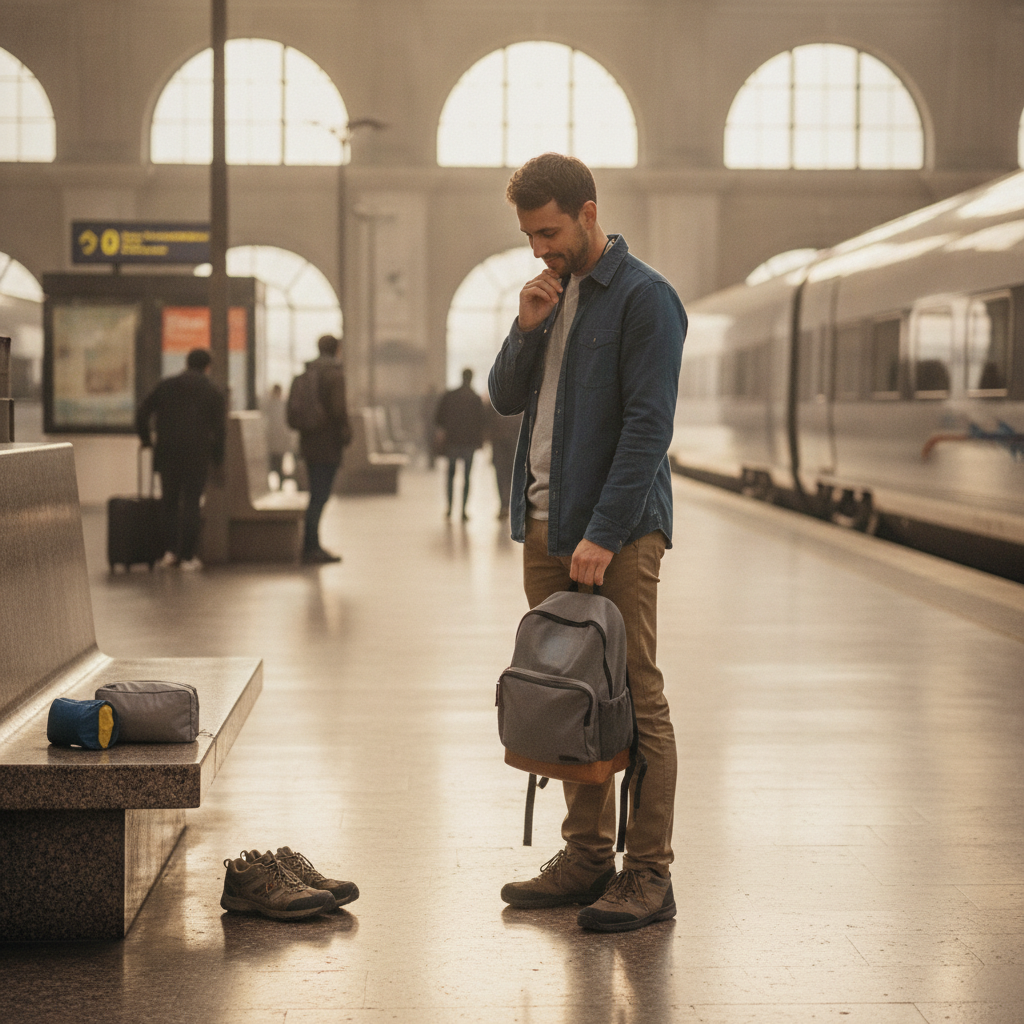
There is a particular kind of clarity that arrives when a person stands at a departure gate holding nothing but a single small bag. No checked luggage receipt, no wheeled suitcase nudging other travelers' ankles, no overhead bin negotiation. Just a compact carry-on tucked under the seat ahead and, somewhere in the quiet hum of a boarding announcement, the slow realization that everything needed for a week of living fits within arm's reach. The experience is disorienting at first, and then unexpectedly instructive — not about packing technique, but about the invisible habits that quietly govern everyday life.
The Weight of What Gets Left Behind
Challenging yourself to travel with only a personal item — typically a bag no larger than what fits under an airline seat, often around 18 by 14 by 8 inches depending on the carrier — forces an immediate reckoning. Every item must justify its presence. The backup shoes, the just-in-case cardigan, the triple-redundant toiletry kit: none of them make the cut, and in their absence, something interesting happens. The traveler begins to see not what they need, but what they habitually reach for without thinking. That distinction is more revealing than any packing list. Brands like Aer and Bellroy have built entire product lines around this constraint, and their popularity suggests that many people are drawn to the exercise not purely for convenience, but for what the limitation teaches them about themselves.
The physical act of editing a week's worth of belongings into a single compartment functions almost like a personality audit. Choices become conscious where they were once reflexive. A person who discovers they've packed four variations of the same neutral shirt learns something about the anxiety they carry around being underprepared. Someone who finds themselves agonizing over whether to bring a book or an e-reader is really confronting a deeper question about how they unwind and what they think travel is supposed to look like. The bag becomes a small, honest mirror.
Discovering the Actual Shape of Daily Routine
One of the more surprising lessons of extreme light packing is what it reveals about the texture of ordinary days. At home, routine is supported by an elaborate infrastructure — the specific moisturizer on the bathroom shelf, the particular mug, the playlist that only works on a certain speaker. Travel strips that infrastructure away, and what remains is a clearer view of which habits are essential and which are simply comfortable accumulations. A traveler spending a week moving between, say, Lisbon's Alfama district and a quieter town in the Alentejo region discovers quickly which morning rituals actually matter and which were just filling time.
This stripping down has a name in Japanese minimalist philosophy: ma (間), which refers to the productive emptiness between things — the pause that gives meaning to what surrounds it. When the usual clutter of objects is removed, the shape of what remains becomes legible. Travelers who return from personal-item-only trips often report not a sense of having suffered through deprivation, but of having seen their routines with unusual clarity. They notice, perhaps for the first time, that they spend a disproportionate amount of morning energy managing objects rather than actually preparing for the day.
What Re-Wearing Reveals
Packing light inevitably means wearing the same pieces multiple times, and this constraint quietly dismantles one of the more persistent habits of modern dressing: the assumption that each day requires a visually distinct outfit. On a week-long trip with a personal item, the traveler typically selects three or four versatile pieces — perhaps a merino wool base layer, a pair of dark trousers that read as both casual and polished, a single jacket — and rotates them with intention. The wardrobe capsule that travel writers describe in destinations like Copenhagen or Tokyo, where functional minimalism in clothing is a cultural norm, stops being an abstract concept and becomes a lived experiment.
What emerges is a different relationship with clothing itself. Pieces get evaluated not for novelty but for utility, adaptability, and comfort over sustained wear. Many travelers discover that they enjoy their trip more when they stop thinking about what they're wearing. The cognitive space previously occupied by outfit decisions gets reallocated toward noticing — the afternoon light on a particular street, the way a neighborhood transitions block by block, the quality of attention that's only possible when the mind isn't managing logistics.
Coming Home to a Different Perspective
The return from a personal-item-only trip tends to be its own kind of education. You walk back into a home that suddenly looks full in a way it didn't before departure. The closet, the medicine cabinet, the kitchen counter — spaces that once felt familiar now register as dense with accumulated choice. This isn't an invitation to wholesale minimalism, and it isn't a criticism of owning things. It's more like returning with a calibrated eye, able to see what's actively used versus what simply occupies space out of inertia.
Many travelers find themselves making small, deliberate changes after this experience — not dramatic purges, but quiet recalibrations. They start reaching for the same reliable pieces more often. They stop buying toiletries in bulk because a week of travel proved that the small sizes are more than sufficient. They might begin thinking about their daily bag the way they thought about their travel bag: does everything in here have a reason to be here? Apps like PackPoint or Packing Pro, which many light travelers use to pre-plan and reflect on what they actually used versus what went untouched, become tools for ongoing self-awareness rather than just pre-trip logistics.
There is a particular kind of clarity that arrives when a person stands at a departure gate holding nothing but a single small bag. The lesson, it turns out, isn't really about luggage at all. It's about the countless small decisions that accumulate into a way of living — and the remarkable utility of occasionally stepping outside that accumulation long enough to see it whole. The bag under the seat isn't just a packing achievement. It's a compressed record of what a person, given a week and a set of constraints, decides actually matters.